- August 7, 2026
- Posted by: SVB
- Categories: Featured Articles, Features, Home News, Industry News, News
With UEFA confirming plans to extend its Standing Facilities Observer Programme across UEFA Club Competitions and national team matches in the 2026/27 season, and more clubs within the UK offering licensed safe standing, understanding how the SGSA regime works in practice, and what it means for stadium operations, is business critical.
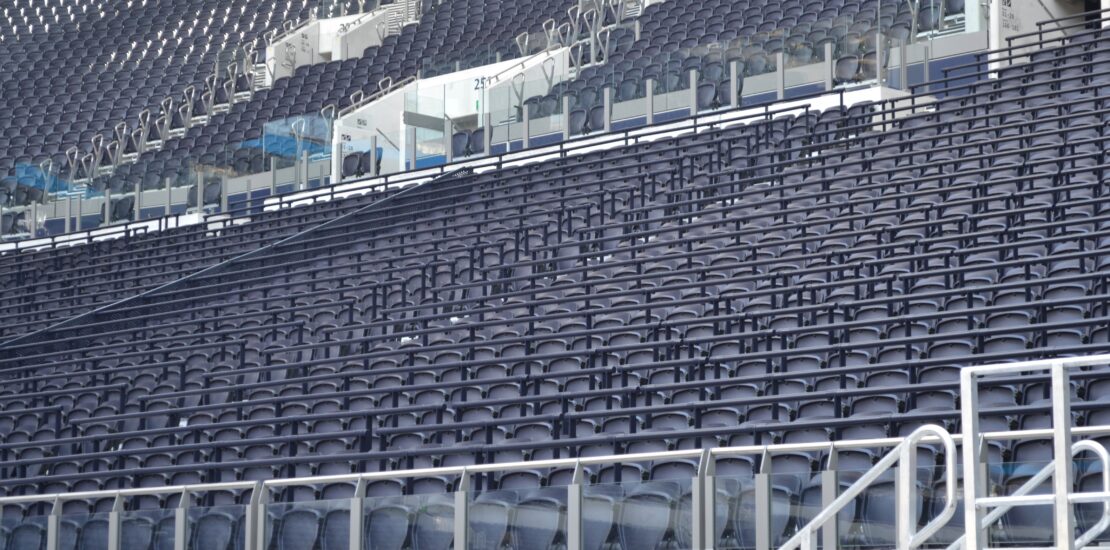
The reintroduction of licensed safe standing across Premier League and EFL stadiums has become one of the most significant developments in spectator management in recent years. Following successful trials and widespread adoption, only one Premier League club, Fulham FC at Craven Cottage, is yet to install a licensed safe standing area.
For many clubs, safe standing offers an opportunity to enhance matchday atmosphere, better manage persistent standing and provide supporters with greater choice within existing stadium infrastructure.
However, behind the fan experience lies a robust regulatory framework that places considerable responsibilities on stadium operators and facilities teams. Licensed safe standing is not a return to the terraces of previous decades. Instead, it is a carefully controlled model governed by stringent safety, operational and compliance requirements. Understanding the licensing process, and its implications for stadium design, construction and day-to-day operations, is essential for the successful delivery and long-term management of these areas.
The 2026 SVB LIVE Conference & Exhibition – focused on elevating the live experience across sports and entertainment – is being hosted at Everton FC’s spectacular new Hill Dickinson Stadium, Oct 1st and 2nd, with an Opening Night Icebreaker at Liverpool FC’s iconic Anfield Stadium, Sept 30th.
Here, Carly Thorpe a Partner in law firm Walker Morris’s Construction & Engineering team and Associate Jonathan Coser, explain the six key areas everyone in sports venues should understand.
How safe standing is regulated
Licensed safe standing is permitted under the Football Spectators (Seating) Order 2022, subject to approval by the Sports Grounds Safety Authority (the “SGSA”). The SGSA oversees the process and assesses compliance against its published guidance, including the Guide to Safety at Sports Grounds (the “Green Guide”) and Supplementary Guidance 01: Safe Standing in Seated Areas.
Approval is not automatic. Each standing area must satisfy a detailed licensing regime that covers physical infrastructure, design, safety management arrangements and engagement with local Safety Advisory Groups and authorities.
A key feature of the regime is timing. The SGSA does not grant approval at design stage or before works start on site. Instead, a licence can only be applied for once the installation is complete and the standing area is operationally ready for use.
For stadium operators, this means that regulatory scrutiny is concentrated at the end of the project rather than at the beginning.
Why operational input matters early
Because licensing occurs after construction is complete, compliance is assessed based on how the standing area functions in practice. Issues such as spectator movement, stewarding arrangements, CCTV coverage, sightlines and accessibility are all considered alongside the physical installation itself.
In retrofit projects, particularly in older stadiums, these issues can be more challenging than anticipated. Existing structures may limit space, restrict circulation routes or complicate sightline and accessibility arrangements. Standing areas also place different demands on safety management procedures compared to seated accommodation, requiring close coordination between operations, safety officers and stewards.
Where facilities teams are involved early (during design development and procurement) potential operational challenges can be identified and addressed before they become obstacles to licensing.
Common challenges in retrofit schemes
Many safe standing projects are delivered within existing stands that were not designed with modern standing systems in mind. Operators may encounter issues such as:
- reduced row depths or constrained standing widths compared to current guidance expectations;
- the need to adapt CCTV, control room layouts or stewarding positions to maintain effective crowd monitoring;
- sightline impacts for adjacent seating areas, including accessibility implications;
- additional strengthening works to support barriers or increased crowd movement.
These challenges are not unusual, but they can affect programme and operational readiness if they are only identified once works are nearing completion.
Linking construction and operations
Safe standing highlights the importance of integrating construction delivery with operational planning. While contractors may focus on physical compliance, it is the operator who must demonstrate that the standing area can be safely managed on matchdays.
Close collaboration between project teams, facilities management, safety officers and local authorities helps ensure that operational arrangements evolve alongside the physical works. Trial events, mock matchdays and early regulator engagement are increasingly used to test assumptions and refine procedures ahead of licensing.
Planning for programme certainty
Stadium works are often delivered around live events, fixture schedules and seasonal shutdowns. The licensing process itself takes time and may involve iterations before approval is granted. Allowing realistic time for regulatory engagement (and avoiding assumptions that approval will be immediate ) is critical to protecting matchday operations.
Ultimately, safe standing can be delivered successfully where operational realities are treated as integral to the project, not an afterthought.
A collaborative approach
Much like the game on the pitch, licensed safe standing is a team event and represents a modern, compliance led approach to crowd safety. For stadium operators and facilities managers, success depends on early engagement, clear communication and a shared understanding of how design, construction and operations intersect.
By treating licensing as an operational challenge as much as a construction one, clubs can improve the likelihood of approval while ensuring their standing areas are safe, adaptable and ready for use.
SVB LIVE provides an unrivalled global community, with opportunities to network, collaborate and explore new possibilities year-round via the SVB LIVE Business Club.

Check out the latest sports & entertainment venue development data from across the globe in the exclusive, subscription-only, SVB Global Report here.